


 childsg@nus.edu.sg
  Follow us on LinkedIn
  NUS, Yong Loo Lin School of Medicine

LEarning To Support Play (LET’S Play)
The LET’S Play feasibility trial has ended
What is LET’S Play?
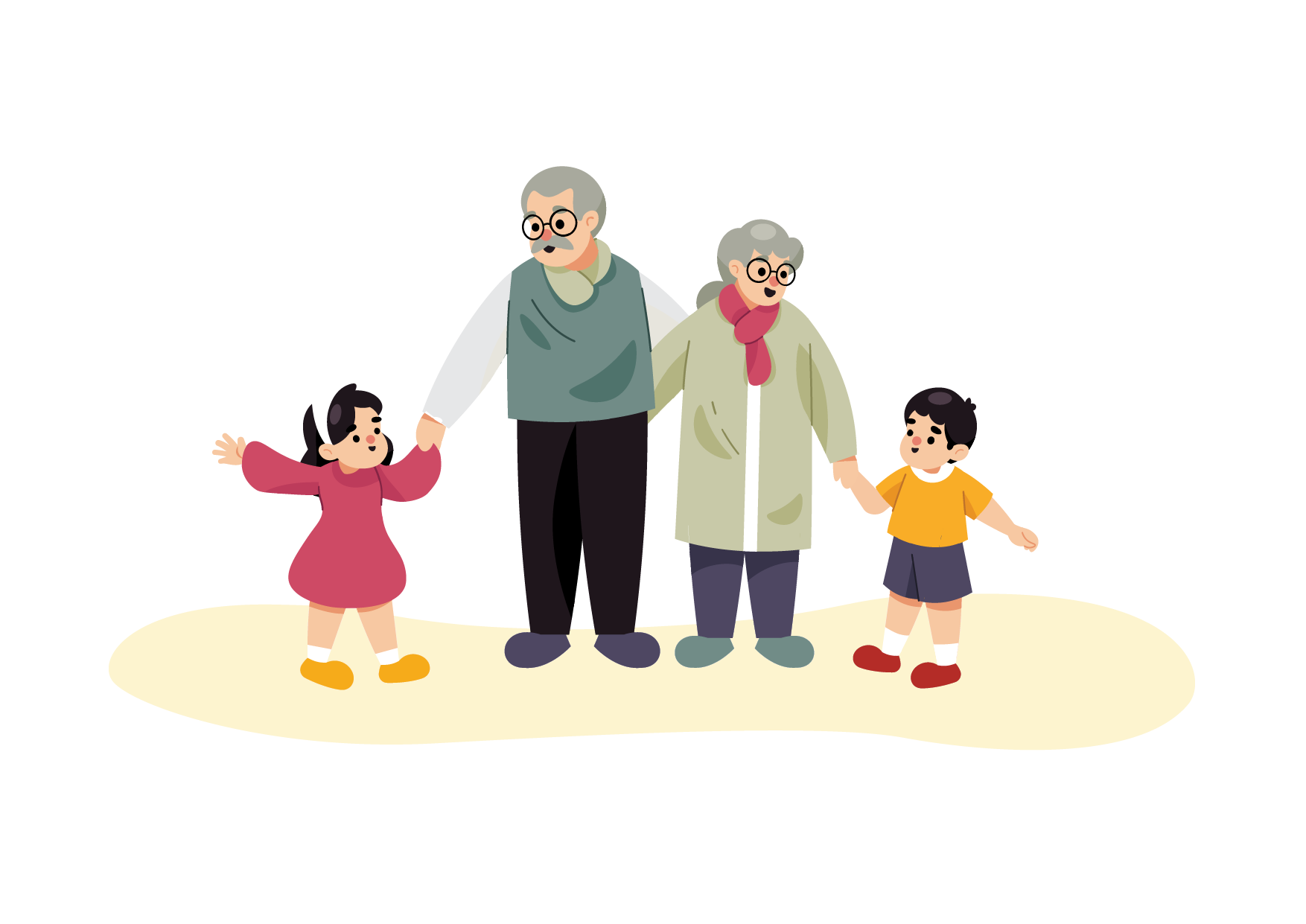
The LET’S Play programme is a research study that involves a free 4-6-session programme designed to help grandparent caregivers observe, understand, and respond better to their young grandchild. It consists of coaching sessions, where the coach taps into the grandparent’s existing caregiving expertise and unique relationship with their grandchild to highlight good caregiving practices and suggest further areas where the grandparent can be more responsive when interacting with their grandchild during play.

What did CHILD, NUS aim to do?
We aimed to learn whether LET’S Play can enhance grandparents’ caregiving responsiveness and sensitivity during play. We were also interested in finding out grandparents’ and parents’ experiences of the LET’S Play programme and how it fits in with their day-to-day life.
What is sensitivity and responsiveness in caregiving, and why is it important?
Being a sensitive and responsive (grandparent) caregiver means being aware of children’s cues and responding appropriately and consistently. A sensitive caregiver understands what a young child needs through the child’s facial expressions, movement, sounds and words. The caregiver then responds consistently to the child in ways that are helpful, nurturing and in-tune with the child’s intentions.
Children of sensitive and responsive caregivers are more likely to show positive outcomes in several areas of development such as social skills, language, emotional, and brain development. For example, helping a young child who is trying to reach for a toy can support the child’s exploration, which helps the young child to be confident and curious about the world.
Why play?
Studies have shown that good-quality play with responsive caregivers is linked with fewer problem behaviours in children (e.g., aggression, defiance, being withdrawn, anxiety). Playful interactions with caregivers are also related to children being more able to manage their emotions and having better social skills, communication skills, and more capacity for empathy in adolescence.
Who was involved?
We recruited grandparents who were:
- Caring for a child aged 4 months to 48 months old at least 2 days a week, at least 3 hours per day
- Over 50 years old
- Singaporean Citizens or PRs
- Able to read and write English, Mandarin or Malay
- Willing to take part in simple video-recordings (approx. 10 minutes) of them playing with their grandchild
- Able to commit at least 7 hours over 3 months (2 research sessions and the LET’S Play programme)
With parents/legal guardians of the child aged 4 – 48 months old who were:
- Aged 21 and above
- Able to read and write English, Mandarin or Malay; and
- Consented to simple video-recordings (approx. 10 minutes) of their child playing with their grandparent
What was done?
- Attended two research sessions, where they filled out a simple questionnaire related to their perceived confidence, capability, and skills related to play and caregiving and took part in a 10-min video-recording of them interacting with their grandchild (recorded by an NUS-CHILD researcher) during each session.
- Attended four coaching sessions at their homes to review the video recordings and identify better ways to understand and respond to their grandchild.
- Attended a focus group discussion to share their experiences and feedback after the end of the programme.
- Attended two research sessions, where they filled out a simple questionnaire related to their child’s social and emotional development.
- Attended an introductory session to learn more about the programme.
- Attended a focus group discussion to share their experiences and feedback after the end of the programme.
Participants received free take-home materials upon participating in the intervention.
To find out more, contact us at lets.play@nus.edu.sg.
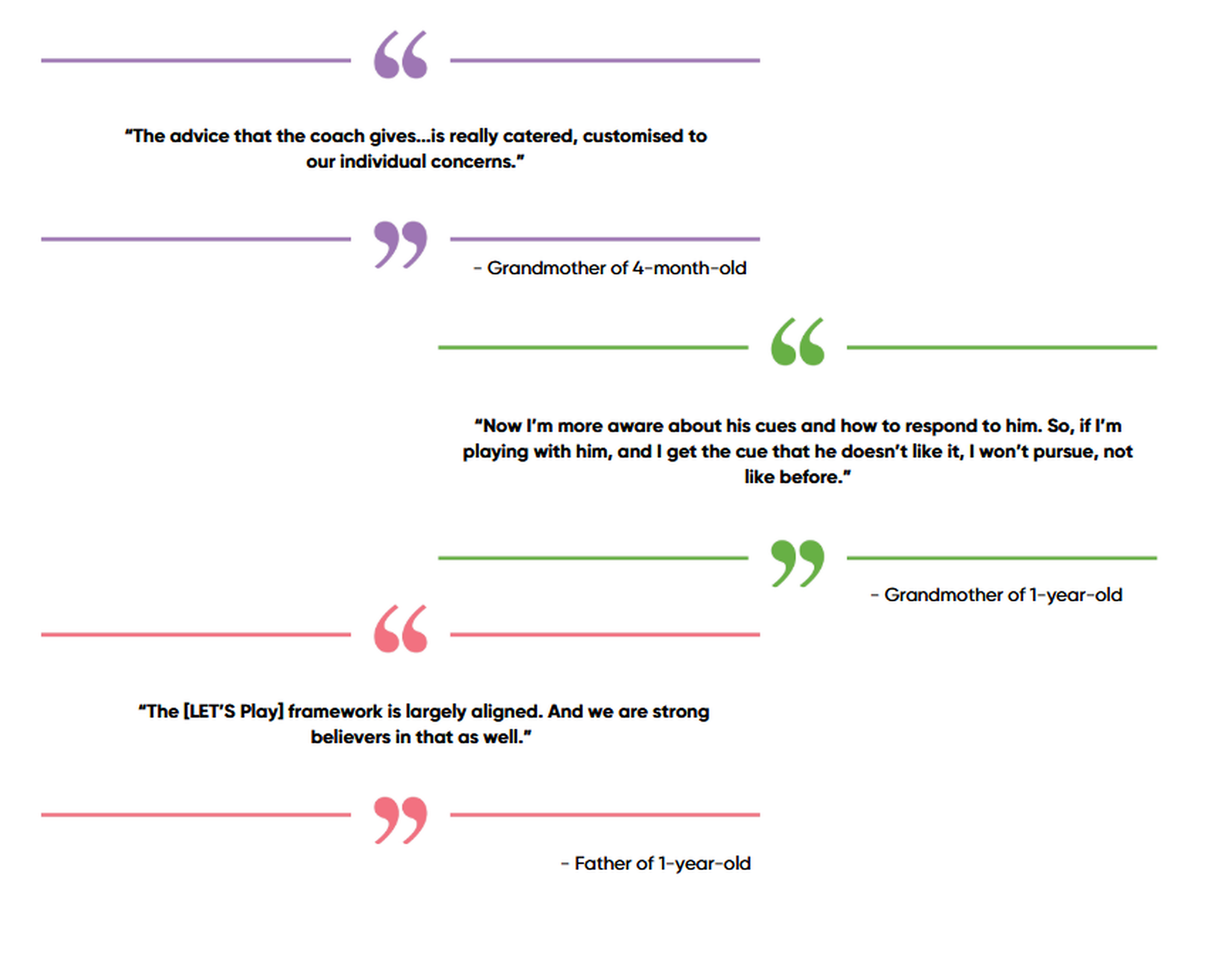
What participants felt about LET’S Play
What’s next?
The valuable insights from the feasibility trial informed the development of LET’S Care, a training programme for domestic helpers caring for young children in Singapore. These insights also guided the creation of a series of video resources on responsive caregiving. Looking forward, the programme may be expanded to support other caregivers, including grandparents.